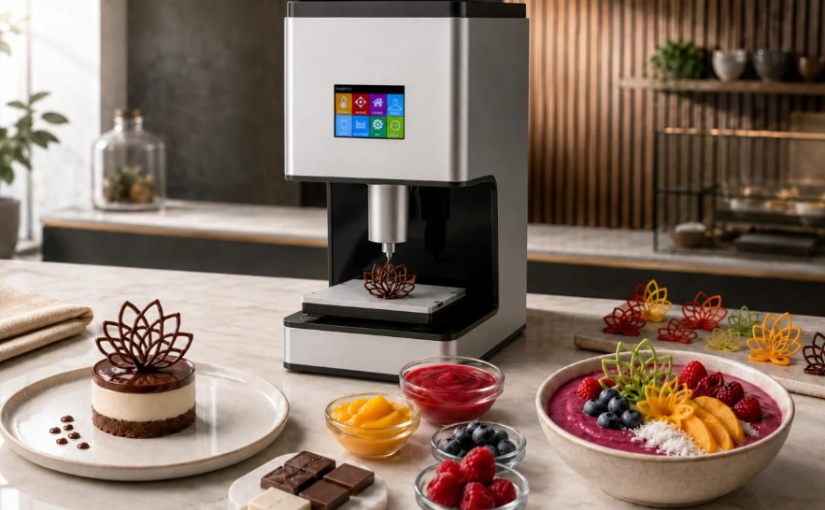
Imagine walking into your kitchen after a long day, opening an app on your smartphone, and choosing a chocolate dessert from a digital menu. Instead of mixing ingredients, measuring flour or spending an hour decorating a cake, you simply press a button. A compact machine begins moving its printing head, carefully layering melted chocolate into a beautiful edible sculpture. Ten minutes later, your personalised dessert is ready.
It sounds like something from a science-fiction film, but 3D food printing is becoming an increasingly interesting area of food technology. Around the world, researchers and technology companies are exploring ways to turn digital designs into real meals, snacks and desserts.
For New Zealand, a country with a strong food culture, a thriving dairy industry and a growing interest in innovative technology, this idea raises an exciting question: could 3D chocolate printers eventually become as familiar as coffee machines and microwave ovens?
When Your Kitchen Becomes a Miniature Chocolate Factory
Traditional baking is built around familiar processes. People mix ingredients, pour mixtures into moulds, place trays in ovens and decorate finished products by hand.
A 3D food printer approaches the process differently. It takes a digital design and transforms it into a physical food creation, building the object layer by layer.
For chocolate printing, the machine generally uses a controlled heating system to keep chocolate at a suitable temperature. A motorised mechanism pushes the melted material through a small nozzle, following instructions generated by specialised software.
The result can be surprisingly detailed.
A machine might produce a chocolate flower, a personalised birthday decoration, a miniature architectural model or even a complicated geometric sculpture. Instead of relying entirely on the skills of a pastry chef, users can experiment with digital designs and let the machine handle much of the precision work.
New Zealand households could find this particularly appealing during birthdays, Christmas celebrations, family gatherings and weekend entertaining.
Imagine making a chocolate fern to decorate a dessert for a dinner party, or printing a miniature silver fern for a special sporting celebration. These creations could give ordinary homemade desserts a distinctive Kiwi touch.
Why New Zealand Could Be an Interesting Market
New Zealand has a special relationship with food. From weekend farmers’ markets and neighbourhood cafés to family barbecues and traditional baking, food is an important part of everyday life.
Chocolate also has a familiar place in local shopping habits. Supermarkets, speciality confectionery stores and independent chocolate makers offer plenty of options for people who enjoy experimenting with sweet treats.
This creates an interesting opportunity for 3D food printing.
Rather than replacing traditional baking, a chocolate printer could introduce another way to enjoy familiar ingredients. It could appeal to people who love technology, families looking for creative activities and home bakers who want to produce something unusual.
New Zealand’s dairy industry could also make the discussion particularly interesting. Milk and dairy ingredients are widely associated with the country’s food identity. Although a chocolate printer does not automatically require locally sourced ingredients, future food-printing systems could create opportunities for experimenting with different chocolate formulations and locally produced ingredients.
A home user might choose a classic milk chocolate design one day and experiment with dark chocolate or alternative recipes the next.
The attraction is not simply about making dessert faster. It is about giving people more freedom to decide what their food looks like.
Could You Design Your Own Chocolate Before Breakfast?
One of the most exciting possibilities is the combination of 3D food printers and smartphone applications.
Picture a simple interface showing dozens of dessert designs. You select a chocolate dinosaur for a child’s birthday, adjust its size, choose a pattern and send the finished design to your kitchen machine.
More advanced systems could eventually allow users to upload their own photographs, drawings or digital models.
A family might turn a child’s hand-drawn picture into an edible chocolate decoration. A couple could create personalised chocolates featuring their initials. Someone preparing a dinner party could design matching decorations for every guest.
The process could become even more interesting when artificial intelligence is introduced.
An intelligent design assistant might suggest suitable shapes based on the amount of chocolate available, the size of a dessert or the occasion. It could also help beginners create attractive designs without needing professional graphic-design skills.
For New Zealand families, this could turn dessert preparation into a shared activity. Children could choose the shapes, parents could manage the ingredients, and everyone could watch the machine bring a digital creation to life.
Of course, parents would still need to supervise younger children around heated chocolate and moving mechanical components.
The Technology Behind a Perfect Chocolate Print
A chocolate printer might look simple from the outside, but several electronic and mechanical systems need to work together.
Temperature control is particularly important. Chocolate behaves differently depending on its composition and temperature. If it becomes too warm, printed structures may lose their shape. If it becomes too cool, the material may become difficult to dispense smoothly.
A reliable machine therefore needs sensors that monitor temperature and communicate with its control system.
Motors are equally important. They move the printing head and control how much chocolate is released. Even small inconsistencies can affect the final appearance, especially when producing delicate patterns or detailed decorations.
The electronic control board coordinates these operations, while the screen or wireless connection allows users to select designs and monitor progress.
Portable or compact food-printing devices may also need carefully designed power systems. In some specialised electronic printing equipment, a printer battery can be relevant to supporting mobile operation, although many countertop chocolate printers will rely on mains electricity rather than an internal battery.
This distinction matters because a kitchen appliance designed for continuous heating and motor operation has different energy requirements from a small portable document printer.
From Birthday Cakes to Personalised Kiwi Gifts
The commercial possibilities could extend well beyond ordinary home desserts.
New Zealand has a strong market for tourism experiences, locally inspired gifts and handmade food products. A personalised chocolate printer could offer new possibilities for businesses operating in these areas.
Imagine visiting a gift shop in Rotorua and finding chocolates shaped like local landmarks. A visitor in Queenstown might purchase a personalised chocolate mountain design. Someone exploring Wellington could order a chocolate decoration inspired by the city’s creative atmosphere.
These products could make souvenirs more interactive and memorable.
Small bakeries might also use food printers to create customised cake decorations without requiring every design to be made manually.
For example, a customer ordering a birthday cake could select a printed chocolate nameplate, a decorative pattern or a miniature themed sculpture.
Restaurants could experiment with desserts that combine traditional pastry techniques with digital manufacturing. A simple chocolate mousse might be served with an intricate printed chocolate structure that would be difficult to reproduce by hand.
This would not necessarily mean every restaurant needs an expensive machine. Smaller businesses could begin with shared production facilities or specialised suppliers.
The most interesting possibility is that personalised food could become more accessible to businesses that previously lacked the time or equipment to produce highly detailed decorations.
Could 3D Chocolate Printing Reduce Food Waste?
Food waste is another important issue worth considering.
New Zealand households and businesses regularly face the challenge of managing food purchases, leftovers and unused ingredients. A technology that allows more precise portion control could potentially help reduce certain types of waste.
Traditional baking often involves preparing a large batch of decorations or ingredients, even when only a small quantity is needed.
A food printer could theoretically produce the exact number of chocolate decorations required for a particular order.
For example, a small café might print twelve matching chocolate decorations rather than preparing a much larger batch and storing the extras.
However, this advantage should not be exaggerated. Food printing does not automatically eliminate waste. Machines may still require test prints, cleaning materials and unused ingredients. Poorly planned designs could even increase consumption.
The environmental benefits would depend on how efficiently the equipment operates, how ingredients are sourced and whether businesses can reduce unnecessary production.
For New Zealand food businesses interested in sustainability, these practical considerations would be just as important as the novelty of the technology.
The Challenges Behind the Sweet Technology
Despite its potential, 3D chocolate printing still faces several challenges before it can become a mainstream household appliance.
The first is price.
Advanced food-printing equipment can be expensive, especially when it includes precise temperature controls, specialised printing mechanisms and software. Most households will probably hesitate before purchasing a machine that they only intend to use occasionally.
Ease of cleaning is another major concern.
Chocolate can harden inside small openings and mechanical components. A machine that requires complicated cleaning after every use may quickly become frustrating.
Food safety is also essential. Any appliance that handles edible ingredients must use suitable food-contact materials and allow users to clean the parts that come into contact with food.
Consistency presents another challenge. A beautifully printed chocolate sculpture in a laboratory does not guarantee equally good results in a warm home kitchen.
New Zealand’s changing seasonal temperatures could make this particularly relevant. A machine used in a cool South Island kitchen might behave differently from one operating during a warm summer afternoon in Auckland.
Manufacturers will need to consider these practical conditions when designing products for different households and environments.
Will Chocolate Printers Become the Next Must-Have Kitchen Gadget?
The success of any new consumer appliance depends on more than impressive demonstrations.
People want products that are affordable, reliable and genuinely useful. A machine that creates spectacular chocolate sculptures but takes an hour to clean might attract attention without becoming a regular part of everyday life.
The best opportunity may lie in making the technology simple.
A successful home chocolate printer could feature ready-made designs, straightforward ingredient cartridges, automatic temperature controls and an easy-to-clean printing head.
Wireless connectivity could allow users to download new designs, share creations and customise their desserts from a smartphone.
Battery-powered accessories might also become part of the wider ecosystem. For example, a portable design controller or wireless companion device could use a printer battery where its hardware requires independent power. This would be different from powering the heated chocolate-printing mechanism itself, which generally needs a more substantial energy supply.
Manufacturers would also need to make replacement components and maintenance straightforward. Consumers are more likely to invest in an unfamiliar appliance if they know it can be maintained rather than discarded when one component fails.
For New Zealand shoppers, local availability, product support and clear safety information would also influence purchasing decisions.
A New Kind of Food Creativity for the Next Generation
Perhaps the biggest impact of 3D food printing will not be on professional kitchens but on how younger generations think about food and technology.
Children already interact with digital tools, creative applications and educational technology. A food printer could introduce concepts such as geometry, design, engineering and material science through an activity that feels more like play than a traditional lesson.
Students could design simple edible structures and observe how different shapes affect stability. They could experiment with patterns, dimensions and digital modelling.
Schools and community workshops might eventually use food-printing equipment for demonstrations that combine technology with practical creativity.
The technology could also encourage conversations about nutrition, food production and responsible consumption.
Of course, chocolate should remain an occasional treat rather than becoming the main focus of technology-based food education. Similar printing principles could eventually be explored with other suitable ingredients.
The exciting part is the opportunity to connect digital creativity with something people can actually touch, share and taste.
The Future of Dessert Might Be Printed
It is easy to imagine a future in which the kitchen contains more than an oven, refrigerator and coffee machine.
A compact food printer could sit on the benchtop, ready to create personalised decorations for birthdays, special occasions or an ordinary Friday night.
For New Zealand, the idea fits into a wider conversation about food innovation, creative technology and the future of everyday consumer appliances.
There will still be a place for homemade brownies, traditional pavlova and carefully decorated cakes. Technology does not need to replace these familiar favourites to make an impact.
Instead, it could give home cooks and small businesses another tool for expressing their creativity.
As printing systems become easier to use and more affordable, the boundary between digital design and everyday food could become increasingly blurred.
One day, creating a personalised chocolate fern, a miniature kiwi bird or a complicated geometric dessert might be as simple as choosing a design on your phone.
And perhaps the most surprising part of that future will be that the next exciting kitchen gadget does not just help you cook dinner. It lets you print dessert.