New Zealand’s Love of the Night Sky Is Getting a Technological Upgrade
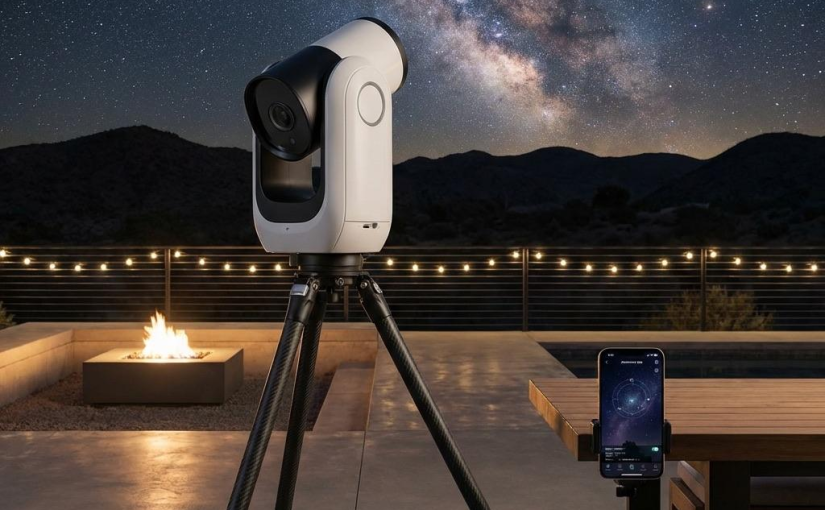
Imagine standing beneath a clear South Island sky, looking up at thousands of stars. The Milky Way stretches across the darkness, the Southern Cross shines above the horizon, and distant galaxies are waiting to be discovered. You take out a telescope, point it towards the sky, and within minutes, a colourful image of a distant nebula appears on your phone.
This might sound like something reserved for professional astronomers, but smart telescopes are making this experience increasingly accessible.
New Zealand is an especially exciting place to explore this technology. From Lake Tekapo and the Mackenzie Basin to Kaikōura and the remote landscapes of Central Otago, the country has some remarkable locations for stargazing. Its dark-sky communities and growing interest in astrophotography are also creating opportunities for ordinary people to become more involved in astronomy.
The big question is whether smart telescopes can make observing the universe easier, more enjoyable, and perhaps even more rewarding than using traditional telescopes.
Why New Zealand Is a Perfect Place for Smart Stargazing
New Zealand has a natural advantage when it comes to observing the night sky. Many areas are far away from major urban centres, meaning there is less artificial light to interfere with astronomical observations.
Lake Tekapo is perhaps the best-known example. Located within the Aoraki Mackenzie International Dark Sky Reserve, it attracts visitors who want to experience a night sky that looks dramatically different from the skies above Auckland, Wellington, or Christchurch.
Other locations are gaining attention too. Naseby in Central Otago became New Zealand’s first certified Dark Sky Community in 2025, reflecting local efforts to protect the natural darkness of the area.
Kaikōura is another interesting example. Its dark-sky community has been investing in equipment that helps residents and visitors explore the stars, including astronomy binoculars and rechargeable red lights.
These developments demonstrate that stargazing is not simply an activity for scientists. It is becoming part of New Zealand’s tourism, outdoor recreation, and community experiences.
Smart telescopes could make these experiences even more accessible. Visitors do not necessarily need years of astronomy knowledge or expensive professional equipment to start exploring the universe.
What Exactly Makes a Smart Telescope Different?
A traditional telescope mainly relies on the user to find and observe celestial objects. Beginners often need to understand star charts, learn how to recognise constellations, and manually adjust the telescope to locate particular stars or planets.
This can be enjoyable, but it also creates a learning curve.
A smart telescope takes a different approach by combining optical equipment, digital cameras, automated tracking, and smartphone connectivity.
Most models use an accompanying mobile application. Users can browse a catalogue of celestial objects, select something interesting, and allow the telescope to locate and track it automatically.
Some models can also capture multiple exposures and combine them digitally. This process, commonly known as image stacking, helps reveal details that might otherwise be difficult to see.
For example, a beginner might select the Orion Nebula through an app. The telescope then adjusts its position, tracks the target, and begins collecting images. As more exposures are combined, the colourful structure of the nebula gradually becomes clearer.
Instead of spending most of the evening trying to locate an object, users can spend more time enjoying what they discover.
From the Southern Cross to Distant Galaxies
One reason smart telescopes are particularly interesting in New Zealand is the opportunity to explore the southern night sky.
Many astronomy guides and beginner tutorials focus heavily on northern hemisphere objects. However, New Zealand observers have access to fascinating southern celestial targets.
The Southern Cross is an obvious starting point. It is one of the most recognisable features of the New Zealand night sky and has an important place in the country’s identity.
Beyond familiar constellations, observers can explore the Jewel Box Cluster, the Large Magellanic Cloud, and numerous star clusters and nebulae.
The Large Magellanic Cloud is particularly exciting because it is a nearby satellite galaxy of the Milky Way. Under suitable conditions, it can be seen without a telescope from a dark location.
A smart telescope can take the experience further by collecting detailed images and allowing users to explore celestial objects through a digital interface.
For families, this creates an interesting opportunity to turn an ordinary evening into an astronomy adventure. Children can choose targets, watch images develop, and learn why different objects appear in different colours and shapes.
Are Smart Telescopes Easier Than Traditional Models?
For beginners, the biggest advantage is convenience.
Traditional telescopes can require patience and practice. Finding a small object in a huge sky is not always straightforward, particularly when someone has never used astronomical equipment before.
Smart telescopes reduce some of these challenges through automatic positioning, object databases, and guided smartphone controls.
However, this does not mean traditional telescopes have become unnecessary.
A manual telescope offers a more direct observing experience. Users can look through an eyepiece, adjust the focus themselves, and develop a deeper understanding of how astronomical observation works.
Some astronomy enthusiasts also enjoy the challenge of manually finding objects.
Smart telescopes, meanwhile, are particularly attractive to people who want to discover the sky without spending weeks learning complicated equipment.
There is also an important difference between seeing an object through an eyepiece and viewing a digitally processed image. A smart telescope’s screen may reveal colours and details that are not immediately visible to the naked eye through a conventional telescope.
Neither experience is automatically better. They simply offer different ways to appreciate the universe.
The Astrophotography Revolution Is Just Getting Started
Perhaps the most exciting feature of smart telescopes is their ability to make astrophotography more approachable.
Traditional astrophotography can involve a surprisingly complicated collection of equipment. Enthusiasts may need a camera, a suitable lens or telescope, a stable tripod, a tracking mount, and software for processing images.
Capturing the Milky Way is already a challenge. Photographing distant galaxies or faint nebulae can require even more preparation.
Smart telescopes simplify much of this process by combining several functions into one device.
Newer products are also pushing the boundaries of compact astronomical imaging. Developments in larger camera sensors, optical systems, automated tracking, and image processing are making these devices increasingly sophisticated.
This is particularly relevant to New Zealand, where astrophotography has a strong visual appeal.
In October 2026, New Zealand astrophotographer Evan McKay attracted international attention after capturing a striking night-sky image above Mautohe Cathedral Cove. Unexpected green airglow added another layer of colour to an image featuring the Moon and Milky Way.
Stories like this demonstrate that the New Zealand landscape offers extraordinary opportunities for night photography.
Smart telescopes could help more people experiment with similar creative experiences, even if they do not have the technical background of experienced astrophotographers.
Why Battery Life Matters During a Night Under the Stars
There is one practical detail that beginners sometimes overlook: astronomy equipment needs reliable power.
A smart telescope may spend several hours locating objects, tracking celestial targets, controlling motors, and transferring images to a connected smartphone. These activities can make power management an important consideration.
The situation becomes even more demanding when people travel away from towns and spend an entire evening outdoors.
Astrophotographers using separate digital cameras also need to think about their equipment’s energy requirements. Long exposures, image previews, wireless connectivity, and cold outdoor conditions can all affect shooting time.
This is where choosing a suitable camera battery becomes part of preparing for a successful photography session.
Rather than discovering that a camera has run out of power just as the Milky Way becomes visible, photographers should check battery levels before leaving home and consider carrying a fully charged spare.
A compatible camera battery is also useful for people who want to photograph the surrounding landscape before switching their attention to the stars.
For example, someone visiting Lake Tekapo might photograph the turquoise lake during the afternoon, capture the mountains at sunset, and then spend the evening recording the night sky. Having sufficient camera power makes it easier to enjoy all three experiences without constantly worrying about the next charging opportunity.
It is worth remembering that a smart telescope and a conventional digital camera may use different power systems. Buyers should always check the manufacturer’s specifications rather than assume that one battery type will work across different devices.
Can Smart Telescopes Work Away From Wi-Fi?
This is another important question for New Zealand users.
Some of the most attractive stargazing locations are not close to large towns or reliable internet connections.
Fortunately, many smart telescopes are designed around local device connections and built-in tracking systems. Depending on the model, users may be able to control important functions through a direct wireless connection without relying on continuous internet access.
However, not every feature works offline.
Some applications may need internet access to download object databases, install software updates, or access online services. It is therefore sensible to prepare the telescope before travelling.
Download the necessary applications, check the operating instructions, charge all equipment, and confirm which functions remain available without mobile data.
This small amount of preparation can make a significant difference when exploring remote areas.
It is also worth considering how much power a smartphone consumes during a long night of telescope control. A portable power bank can be useful, especially when several people are sharing the experience.
What Should Beginners Look for When Buying a Smart Telescope?
The growing number of smart telescope products can make choosing the right model confusing.
Instead of automatically buying the most expensive device, beginners should consider how they actually intend to use it.
First, consider portability. Someone planning regular trips around the South Island may prefer a compact model that fits easily into a car.
Second, look at the optical system. Aperture, focal length, sensor size, and image quality all influence what a telescope can capture.
Third, examine the application. A straightforward interface can make a major difference for beginners. Useful features include automatic target selection, tracking, image previews, and clear instructions.
Fourth, check power requirements. Find out how long the telescope operates on a full charge, whether it supports external power, and whether additional accessories are required.
Finally, consider weather resistance and storage. New Zealand’s outdoor conditions can change quickly. Equipment should be protected from moisture, dust, and accidental damage.
A smart telescope should make astronomy more enjoyable, not turn every trip into a complicated equipment-management exercise.
Could Smart Telescopes Make Astronomy a Family Hobby?
One of the most appealing possibilities is that smart telescopes could encourage more families to explore astronomy together.
Children often become fascinated by space, but traditional astronomy equipment can initially feel difficult to operate.
An app-controlled telescope offers a more interactive starting point. Parents can help children select the Moon, identify a planet, or explore a distant star cluster.
The experience can also lead to conversations about science, geography, physics, and the history of space exploration.
For schools and community groups, smart telescopes may offer another way to introduce astronomy through practical demonstrations.
New Zealand already has a strong connection to the night sky through Māori astronomy and the cultural significance of Matariki. Technology can complement these traditions by helping people observe celestial objects while learning about their cultural and scientific importance.
However, the best experiences will still involve more than staring at a screen. Looking up, recognising the stars, and sharing the excitement of discovering something unfamiliar remain essential parts of stargazing.
The Future of Stargazing in New Zealand
Smart telescopes are unlikely to replace every traditional telescope. Experienced astronomers will continue to value manual observation, specialist equipment, and the satisfaction of finding celestial objects independently.
But for newcomers, travellers, families, and casual astrophotographers, these devices offer an appealing alternative.
New Zealand has the landscapes, dark-sky destinations, and growing astronomy community to make this technology particularly interesting.
Imagine arriving at a campsite near Lake Tekapo, setting up a compact telescope, connecting your phone, and exploring a galaxy millions of light-years away. You do not need to be a professional astronomer to appreciate that moment.
As optical technology, sensors, software, and portable power solutions continue to improve, exploring the universe may become easier than ever.
Perhaps the biggest change will not be that smart telescopes make everyone an astronomer. It will be that more people feel confident enough to look up, ask questions, and discover just how much is happening beyond the stars they can see with their own eyes.