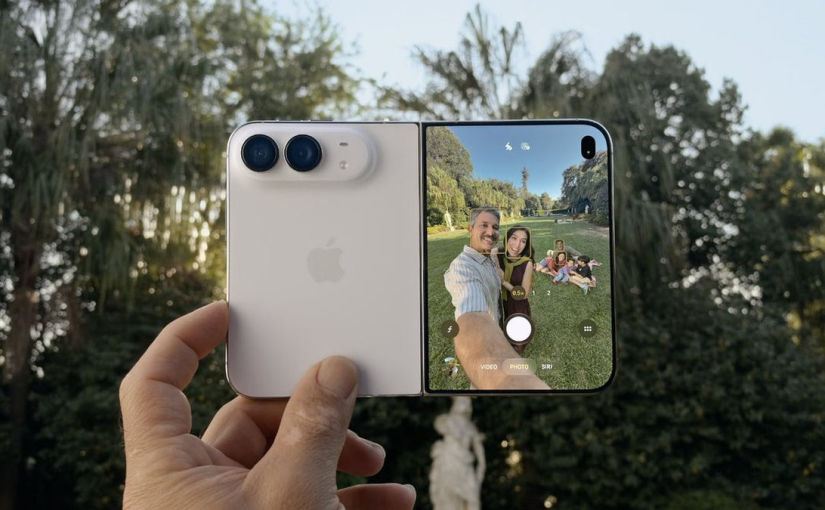
A New Chapter for the iPhone in New Zealand
For years, buying a new iPhone in New Zealand has usually meant choosing between screen size, camera performance, storage, colour and price. The basic shape of the smartphone has remained familiar. That has now changed.
Apple has officially entered the foldable smartphone market with the new iPhone Duo, its first foldable iPhone. The device was unveiled during Apple’s September 2026 launch event and has immediately become one of the biggest stories in consumer technology. For New Zealand shoppers, however, the excitement comes with a major question: is a radically different iPhone worth paying a radically higher price for?
The iPhone Duo opens from a compact smartphone into a much larger display, creating a device that sits somewhere between a traditional phone and a small tablet. Apple says the product is designed to combine portability with a larger workspace, while retaining the familiar iPhone experience.
New Zealand is officially part of the launch story. Apple lists the iPhone Duo with a recommended retail price starting at NZ$4,199 including GST, with storage options ranging from 256GB to 2TB. The device is scheduled to become available in October.
That price places the Duo firmly in premium territory. It is not simply another upgrade for consumers who replace their phones every two or three years. Instead, it is a test of whether New Zealand shoppers are ready to spend laptop-level money on a phone that can transform into something much closer to a tablet.
Why Foldable Phones Are Suddenly More Interesting
Foldable phones are not new. Samsung, Google and several other manufacturers have already spent years experimenting with flexible displays, hinge mechanisms and new software interfaces.
Apple’s arrival is different because of the company’s influence over consumer behaviour.
When Apple adopts a product category, people who previously ignored that category often start paying attention. The same thing happened with wireless earbuds, smartwatches and other connected devices. The iPhone Duo could therefore bring foldable phones into the mainstream conversation in New Zealand.
For many consumers, the biggest attraction is obvious. A conventional smartphone is excellent for messaging, navigation, photography and social media, but its relatively small display can become limiting when users want to multitask.
A larger internal screen changes that experience.
Someone travelling around New Zealand could use the outer display while walking through Wellington or Auckland, then open the phone to study a map, compare accommodation options or manage several apps at once. A university student could read documents while taking notes. A business traveller could respond to emails without carrying a tablet.
The appeal is not necessarily about having more power. It is about making one device useful in more situations.
The Price Question Will Be Difficult to Ignore
The biggest obstacle for the iPhone Duo may not be its technology. It may be its price.
At NZ$4,199, the Duo is dramatically more expensive than a conventional premium smartphone. That puts it in a category where consumers will naturally begin comparing it with laptops, tablets, cameras and other major purchases.
For New Zealand households dealing with the cost of living, that comparison matters.
A buyer may love the idea of a foldable iPhone but still decide that a regular iPhone paired with an iPad or MacBook offers better overall value. Others may see the Duo as a replacement for several devices and therefore consider the premium easier to justify.
This creates an interesting psychological shift. Traditional smartphone upgrades are often about getting a better version of something people already own. A foldable phone asks consumers to reconsider what the phone itself should be.
That makes the purchasing decision much more personal.
Battery Life Becomes Even More Important
A larger display, more demanding multitasking and a sophisticated folding mechanism naturally make battery performance an important consideration.
For everyday users, battery life can matter more than processor benchmarks. New Zealanders who spend weekends hiking, travelling between cities or exploring outdoor destinations may not always have convenient access to a power outlet.
That is why the conversation around an iphone battery is likely to remain important even as manufacturers focus on flexible screens and advanced processors.
Consumers increasingly expect smartphones to survive a full day of navigation, photography, streaming, messaging and social media without constantly searching for a charger. A premium phone costing thousands of dollars is expected to deliver not only impressive specifications but also dependable everyday endurance.
Battery health is another consideration. A smartphone can remain fast and attractive for years, but declining battery capacity can eventually change the ownership experience. Buyers considering an expensive device may therefore think more carefully about long-term battery performance than they would with a cheaper phone.
For the iPhone Duo, this becomes particularly relevant because consumers are not simply purchasing a new screen design. They are investing in a completely new form factor.
A Foldable iPhone Could Change Mobile Photography
Photography is another major reason New Zealand consumers may be interested in the new generation of iPhones.
New Zealand offers an unusually wide range of photographic environments, from Auckland’s urban skyline to the beaches of Northland, the mountains of the South Island and the landscapes around Queenstown.
A phone that can function as both a compact camera and a larger viewing device could appeal to travellers and content creators.
The larger internal display could also make editing photographs and videos more comfortable. Instead of immediately transferring content to a laptop or tablet, users may be able to complete more creative work directly on their phone.
That matters because modern smartphone ownership is increasingly about creation rather than consumption.
People are no longer using their phones only to scroll through social media. They record short videos, edit photographs, manage online businesses, create travel content, attend meetings and communicate with customers.
A flexible screen could therefore have practical advantages beyond simply looking futuristic.
New Zealand Consumers Are Becoming More Selective
The premium smartphone market is becoming more complicated.
Consumers have more choices than ever, while the differences between flagship devices can sometimes appear surprisingly small. A camera may be slightly better, a processor slightly faster or a display slightly brighter, but none of those improvements necessarily creates a completely different user experience.
Foldable technology changes that equation.
The form factor itself becomes the selling point.
Instead of asking whether a phone is 10 percent faster, buyers can ask whether they want a phone that opens into a larger screen. That is a much easier difference to understand.
At the same time, New Zealand shoppers are known for looking carefully at value. A product may attract huge attention online but still struggle to achieve mass-market adoption if the price is too high.
The iPhone Duo therefore faces an unusual challenge: it needs to be exciting enough to justify its premium while being practical enough to become part of everyday life.
The Repair and Longevity Conversation
Premium electronics increasingly raise questions about longevity.
When someone spends more than NZ$4,000 on a smartphone, they are unlikely to think of it as a disposable gadget. They will want to keep it functioning for as long as possible.
That makes durability, software support, battery health and repair options increasingly important.
Foldable devices introduce additional complexity because they contain moving parts and flexible display technology. Consumers may naturally wonder how the hinge will perform after years of opening and closing, how the internal screen will age and how expensive repairs could become.
For New Zealand buyers, those concerns can influence the real cost of ownership.
The same principle applies to the iphone battery. A device can have excellent specifications on launch day, but long-term value depends on how well its key components perform after hundreds or thousands of charging cycles.
A premium smartphone should therefore be judged over several years rather than several weeks.
The iPhone Duo Versus the Conventional iPhone
The most important question is not whether the Duo is technically impressive. It clearly represents a major change in Apple’s smartphone design.
The real question is whether ordinary users actually need that change.
For someone who mainly uses a phone for messaging, banking, navigation, calls and social media, a conventional iPhone may remain the more sensible choice.
For power users, however, the calculation is different.
People who regularly multitask, edit video, read documents, work remotely or travel extensively may appreciate the larger screen. The ability to carry one device instead of a phone and tablet could make the premium easier to understand.
This could create two very different audiences in New Zealand: practical buyers who prefer established designs and technology enthusiasts who want the newest possible experience.
Both groups can be right.
Apple’s Ecosystem May Be the Biggest Advantage
Apple’s greatest advantage may not be the folding display at all.
It is the ecosystem surrounding the iPhone.
Many New Zealand consumers already use Apple Watches, AirPods, Macs and iPads. The iPhone Duo can therefore enter an environment where other devices already communicate with one another.
That makes the decision less about buying one smartphone and more about extending an existing digital lifestyle.
A user could start a task on the Duo, continue it on a MacBook and receive notifications through an Apple Watch. AirPods could remain connected while moving between devices.
For people already invested in Apple’s ecosystem, this convenience can be difficult for competitors to replicate.
It also explains why Apple’s foldable phone launch matters beyond the device itself. The company is not simply selling a new screen. It is attempting to redefine how its entire ecosystem fits into consumers’ daily routines.
What This Means for the Future of Smartphones
The iPhone Duo may eventually prove to be either a revolutionary turning point or an expensive experiment.
Both outcomes would still be significant.
If New Zealand consumers embrace the device, competitors will have even more reason to develop thinner, lighter and more durable foldable phones. Prices could eventually fall as the technology becomes more common.
If adoption remains limited, manufacturers may reconsider how much consumers are actually willing to pay for radically different smartphone designs.
Either way, the competition will benefit consumers.
More competition usually encourages better displays, improved hinges, stronger batteries, better software and more flexible designs. It can also accelerate innovation in accessories such as cases, chargers and portable power solutions.
That means the impact of the Duo could extend far beyond Apple’s own sales figures.
A New Kind of Smartphone Buyer
The arrival of the iPhone Duo is ultimately about more than a foldable screen.
It reflects a broader change in the way people think about personal technology. Smartphones are becoming increasingly powerful, versatile and expensive. Consumers now expect them to replace cameras, entertainment devices, navigation tools, payment cards, communication platforms and sometimes even computers.
That makes reliability more important than ever.
A premium smartphone needs to perform consistently whether someone is commuting through Auckland, working from a café in Wellington, travelling through the South Island or spending a weekend away from the city.
For that reason, details such as battery health cannot be ignored. The future of smartphones will not be determined only by how impressive a device looks when it is opened. It will also depend on how well it performs after months and years of real-world use.
The iphone battery may sound like a small component compared with a revolutionary folding display, but for everyday users, it can determine whether an expensive phone feels genuinely useful or frustratingly inconvenient.
Will Kiwis Buy Into the Foldable Future?
The iPhone Duo has arrived at a fascinating moment for New Zealand’s technology market.
Consumers are surrounded by smarter devices, faster networks and increasingly sophisticated digital services. At the same time, shoppers are becoming more conscious of price, longevity and practical value.
Apple’s first foldable iPhone sits directly in the middle of that tension.
It offers a dramatic new design, a much larger internal display and the familiarity of the iPhone ecosystem. But its premium price means buyers will need a compelling reason to choose it over a conventional smartphone.
For technology enthusiasts, that reason may simply be the excitement of owning something genuinely different.
For professionals, travellers and creators, the larger screen could provide practical benefits that justify the investment.
For everyone else, the conventional iPhone may continue to make more financial sense.
What is certain is that Apple’s move has changed the conversation. Foldable phones are no longer simply an experimental category dominated by other manufacturers. Apple has now entered the field, and New Zealand consumers have a new option to consider.
The next few months will reveal whether the iPhone Duo becomes a niche luxury, a serious productivity tool or the beginning of a much larger transformation in the smartphone market.
One thing is already clear: the future of the smartphone in New Zealand just became considerably more interesting.