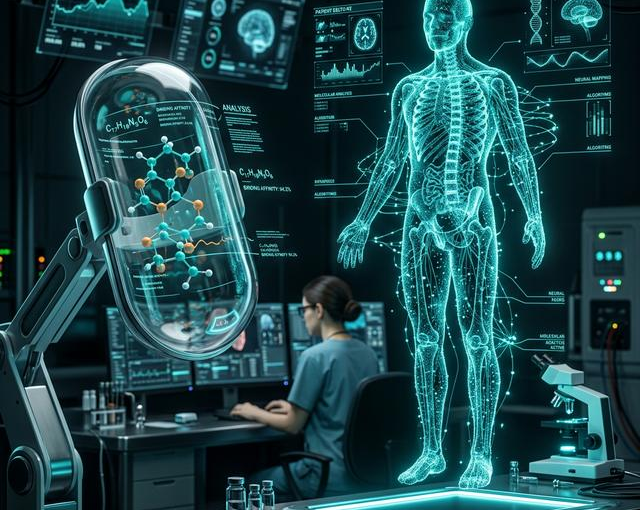
Why Digital Twins Are Becoming a Major Healthcare Opportunity
Imagine visiting a doctor who can do more than review your latest test results. Instead, the clinician can examine a dynamic computer model of your body, explore how a condition might develop, and compare potential treatment options before making a decision. This is the promise of digital twins in healthcare, an emerging technology that could help New Zealand move towards more personalised medical care.
A digital twin is a virtual representation of a real person, organ, or biological system. When researchers combine medical imaging, physiological measurements, clinical records, and sensor data, they can build computational models that help explain how the body works. As new information becomes available, the model can be updated to reflect changes in the patient’s condition.
For New Zealand, this technology is particularly interesting because it connects local biomedical research with a practical challenge facing healthcare systems around the world: how to deliver better-informed treatment while making the best use of limited clinical resources.
The University of Auckland’s Auckland Bioengineering Institute is contributing to international research into patient-specific models, including the European VITAL project, which investigates how digital representations of the human body could support cardiovascular diagnosis and treatment. The work demonstrates that digital twins are not simply futuristic visualisations. They are research tools designed to answer specific clinical questions.
How a Virtual Model of the Human Body Could Work
Creating a useful digital twin requires more than collecting large amounts of health information. Researchers must determine which measurements matter, how different biological processes interact, and whether a model can make predictions that are reliable enough to inform clinical decisions.
For example, cardiovascular researchers may combine medical imaging with measurements of blood flow, pressure, and heart function. A computational model can then help investigate how the heart and blood vessels respond under different conditions. Researchers may use simulations to explore possible outcomes, identify patterns, and develop questions for further clinical investigation.
Wearable technology could contribute another important layer. Devices that measure heart rate, activity, sleep, or other physiological signals can provide information between medical appointments. In the right clinical setting, these measurements may help researchers understand how a person’s condition changes over time rather than relying exclusively on occasional hospital visits.
However, more data does not automatically mean better healthcare. Measurements can be incomplete, inaccurate, or affected by everyday circumstances. A model must also account for differences between individuals and clearly communicate uncertainty. A digital twin should therefore support a qualified clinician’s judgement, not replace it.
Why New Zealand Has a Strong Reason to Explore the Technology
New Zealand’s geography creates distinctive healthcare challenges. People living in rural communities may face long journeys to specialist appointments, while hospitals must coordinate services across widely separated locations. Access to specialist expertise can be especially important when a condition requires detailed assessment or ongoing monitoring.
Digital modelling could eventually help clinicians prepare for complex cases, compare treatment scenarios, and share relevant insights with specialists in other locations. If a model helps a medical team understand a patient’s condition before a consultation, it may make discussions more focused and help identify which additional tests are necessary.
The potential benefits extend beyond major hospitals. Properly designed digital systems could help connect community healthcare providers, specialists, and research institutions. For rural patients, the goal would not simply be to introduce another application or dashboard. It would be to make specialist knowledge more useful and accessible without requiring every patient to travel for every stage of assessment.
Yet technology alone cannot solve geographical inequality. Reliable internet access, appropriate clinical equipment, trained staff, and clear referral pathways remain essential. New Zealand would need to ensure that digital health investments benefit rural communities as well as patients who already have convenient access to advanced medical services.
From Research Laboratories to Real Clinical Decisions
The biggest question is how digital twins can move from promising research projects into routine medical practice.
A model may perform well in a laboratory but still struggle when used with incomplete records, different imaging systems, or patients whose circumstances differ from those represented in its training data. Before a clinician relies on its predictions, researchers must establish what the model can accurately predict, where it is less reliable, and how its performance compares with existing clinical methods.
New Zealand’s research partnerships offer a valuable foundation for this work. International collaboration can provide access to broader datasets, specialist expertise, and different approaches to validating computational models. It can also help local researchers test whether findings from overseas populations apply to New Zealand patients.
The process must include meaningful clinical evaluation. Researchers need to establish whether a model improves decisions or patient outcomes, not merely whether its calculations are technically impressive. They must also consider the time required to use the system, the training clinicians need, and whether the technology fits naturally into existing workflows.
For patients, the most valuable result may be a clearer explanation of their options. A sophisticated simulation is useful only if it helps clinicians communicate what the evidence means, what remains uncertain, and why a particular treatment is being considered.
The Essential Role of Reliable Medical Devices
Digital twins depend on information gathered from real people, which makes the physical equipment behind that information critically important. Medical imaging systems, bedside monitors, wearable sensors, and portable diagnostic devices must operate reliably if their measurements are to support meaningful analysis.
Power management is part of this wider reliability challenge. A portable monitor that stops working during a measurement session may leave gaps in a patient’s record. A wearable sensor that repeatedly loses power may produce inconsistent data. Hospital teams also need dependable procedures for charging, inspecting, maintaining, and replacing equipment used in patient care.
This is one reason medical battery technology deserves attention alongside advances in medical software. The power systems used in healthcare devices must match their specific electrical, safety, and operating requirements. Depending on the equipment, manufacturers may need to consider operating time, charging behaviour, temperature performance, battery management, and reliable power delivery.
These requirements vary considerably between devices. A compact wearable monitor has different needs from a bedside diagnostic instrument or a mobile imaging system. There is no single battery specification that suits every medical application, and selecting an appropriate power solution requires attention to the device manufacturer’s design and safety requirements.
Personalisation Must Include Privacy and Fairness
Digital twins may rely on sensitive information, including medical images, physiological measurements, treatment histories, and genetic data. Protecting this information is fundamental to public trust.
Patients should understand what information is collected, why it is needed, who may access it, and how it will be protected. Healthcare organisations must also establish appropriate rules for data sharing, retention, security, and secondary research use.
New Zealand has additional considerations around Māori data sovereignty and equitable access to healthcare. The people and communities represented in a dataset should have a meaningful voice in decisions about how that information is governed and used. Models must also be evaluated carefully to determine whether they perform consistently across different populations.
Bias can enter a system when certain groups are underrepresented in the data used to develop or validate it. If a model is less reliable for particular patients, its predictions could reinforce existing inequalities instead of reducing them. Transparent evaluation, appropriate community engagement, and continuing oversight are therefore essential.
Privacy and fairness are not obstacles to innovation. They are conditions for developing technology that people can trust and healthcare professionals can use responsibly.
Could Digital Twins Help Prevent Problems Earlier?
One of the most exciting possibilities is moving from reactive treatment towards earlier intervention. If validated models can identify meaningful changes in a patient’s condition, clinicians may eventually be able to investigate potential problems before they become more serious.
Consider a patient receiving ongoing cardiovascular care. A digital model might combine clinical measurements with selected information collected over time. Researchers could investigate whether particular changes correspond to a greater risk of deterioration and whether those findings can improve follow-up decisions.
However, predictions must be interpreted carefully. A warning generated by an algorithm is not a diagnosis, and an apparently reassuring result does not guarantee that a patient is healthy. Clinical teams need clear thresholds for action, reliable escalation procedures, and evidence that monitoring improves outcomes rather than generating unnecessary alarms.
The same principle applies to connected medical devices. Their value depends on the quality of their measurements, the reliability of their operation, and the ability of healthcare professionals to respond to the information they provide.
For equipment that must collect data consistently, a dependable medical battery can be one part of the wider system supporting continuous monitoring. Power reliability cannot guarantee clinical accuracy, but interruptions can compromise the completeness of measurements and create avoidable operational problems.
Turning Innovation into Practical Value
For hospitals and healthcare technology companies, successful adoption will depend on more than the performance of a digital model. Decision-makers must consider implementation costs, staff training, compatibility with existing systems, cybersecurity, maintenance, and long-term support.
A practical starting point is to focus on a clearly defined clinical problem. Researchers and clinicians might investigate whether a model improves cardiovascular risk assessment, supports treatment planning, or helps interpret complex imaging data. A focused application is easier to evaluate than a broad promise to create a complete virtual version of every patient.
Procurement teams should also consider the reliability of the physical equipment that supports digital healthcare. In addition to software performance, they may need to evaluate serviceability, power requirements, data connectivity, and the availability of appropriate replacement components. A suitable medical battery is only one element of this assessment, but it illustrates how small hardware decisions can affect the operation of a much larger clinical system.
Funding should be tied to measurable benefits. These might include improved diagnostic accuracy, fewer unnecessary investigations, more efficient clinical workflows, or better patient understanding of treatment choices. Projects should also be assessed for their effect on access, ensuring that the benefits are not restricted to well-resourced hospitals or urban populations.
What the Future Could Look Like for New Zealand
Digital twins will not transform healthcare overnight. Developing dependable models, validating their predictions, protecting patient information, and integrating them into clinical practice requires sustained research and careful implementation.
Nevertheless, New Zealand has a meaningful opportunity to contribute to this field through its biomedical engineering expertise, international partnerships, and efforts to develop more personalised approaches to care. The country’s success will depend on connecting research breakthroughs with the everyday needs of clinicians and patients.
The most important measure of progress will not be how realistic a virtual model looks on a screen. It will be whether the technology helps healthcare professionals make better decisions, communicate more clearly, and deliver appropriate care to more people.
If researchers can demonstrate those benefits while maintaining high standards for privacy, fairness, safety, and reliability, digital twins could become a valuable addition to New Zealand’s healthcare toolkit. The future of personalised medicine will ultimately depend on a combination of scientific insight, trustworthy data, dependable medical equipment, and human judgement working together.