Imagine Craving a Hot Pie at 12:30 AM
Imagine driving home through Auckland at half past midnight. The roads are quiet, most bakeries have closed, and the nearest takeaway shop has already switched off its lights. You suddenly remember that you have not eaten dinner. All you want is a hot mince and cheese pie, preferably with a golden, flaky pastry crust and a filling warm enough to make the chilly New Zealand night feel a little more comfortable.
Normally, your choices might be limited to a supermarket snack, a drive-through meal or whatever happens to be left in the kitchen. But imagine walking up to a vending machine, selecting your favourite pie on a touchscreen, tapping your bank card and watching a robotic system prepare your food.
Within moments, a freshly heated pie appears behind a collection hatch.
This is not necessarily a scene from a science-fiction film. New Zealand has already begun experimenting with automated hot-food retail, including the locally developed PieBot system. The idea raises an interesting question: what if robots could make convenient, freshly prepared food available around the clock?
For a country where meat pies are more than just another takeaway snack, this could be a surprisingly exciting development.
Why New Zealand Is the Perfect Place for a Robot Pie Shop
Meat pies occupy a special position in New Zealand’s food culture. They are popular with tradies, students, office workers, travellers and people looking for a quick meal between activities.
A classic mince pie, steak and cheese pie or butter chicken pie can be found in bakeries, petrol stations, cafés and convenience stores throughout the country. For many Kiwis, grabbing a pie is simply part of everyday life.
However, traditional food retailers cannot always remain open throughout the night. A bakery might close in the afternoon, while a small takeaway shop may not have enough customers to justify operating until early morning.
This creates an interesting opportunity for automated food technology.
Consider Auckland’s busy transport areas, university campuses, construction sites, industrial estates and apartment buildings. People living, studying or working in these places may need food outside conventional business hours.
A robot-powered food station could provide another option without requiring a fully staffed shop to operate all night.
The same idea could also work in smaller New Zealand towns, where opening a conventional food outlet around the clock might not be financially practical.
Instead of expecting every bakery to stay open longer, technology could help bring food closer to customers.
Meet PieBot, New Zealand’s Real-Life Step Towards Automated Food Retail
The idea of a robot serving hot pies already has a real-world example in New Zealand.
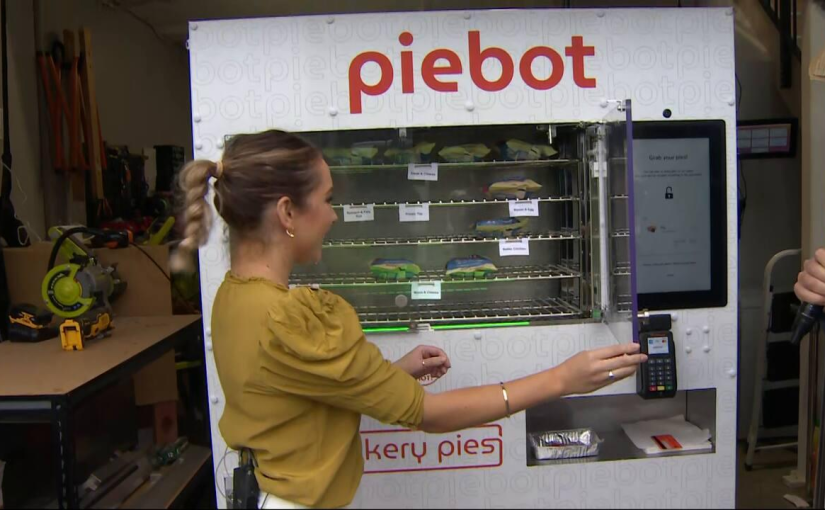
Auckland-based WM Robotics developed PieBot, an automated hot-pie vending system created by engineering graduates Sasha Mates and Vincent Wong.
Their original inspiration came from an unexpected late-night experience overseas. After arriving hungry at a hotel, they discovered that an automated noodle machine was one of the few available food options. They began wondering whether a similar idea could work with something much more familiar to New Zealanders: bakery pies.
The first PieBot machines were launched in 2023. Customers could select their food, tap a payment card, open the cabinet and take the items they wanted. The system would detect what had been removed and charge the customer accordingly.
The concept proved particularly relevant to workplaces and construction sites, where workers might want a hot meal without leaving the premises.
It also demonstrated something important about technology innovation: sometimes the most interesting inventions are not designed to solve complicated scientific problems. They simply make an everyday activity easier.
By September 2026, WM Robotics had expanded its ambitions beyond hot pies. The University of Auckland reported that the company was adapting its self-service technology for chilled and frozen products, including a ready-made meal pilot with My Food Bag.
That development suggests that automated food retail could become much broader than a machine selling one popular New Zealand snack.
How Would a Midnight Pie Robot Actually Work?
A futuristic pie-serving robot would need several systems working together.
The first would be an intelligent ordering interface. Customers could browse available flavours, check prices, see ingredient information and select their preferred meal using a large touchscreen.
The second system would manage food storage and temperature.
Pies would need to be stored safely before being heated or maintained at an appropriate serving temperature. Sensors could continuously monitor internal conditions and notify operators if something fell outside the required limits.
A robotic mechanism could then move the selected pie into a heating compartment, follow a programmed heating cycle and transfer the finished product to a secure collection area.
The most interesting part might be the software controlling the entire process.
Instead of simply responding to customer orders, an intelligent system could analyse purchasing patterns and predict which flavours would be popular at different times.
For example, a machine near an Auckland construction site might sell more steak and cheese pies during early morning shifts. A machine close to a university could experience higher demand during late-night study sessions.
Over time, this information could help operators manage inventory, reduce food waste and make sure popular choices remain available.
The machine would essentially combine a bakery counter, payment terminal, food storage system and automated kitchen into one compact unit.
The Tablet Behind the Counter Could Be More Important Than the Robot
When people imagine food robots, they usually focus on mechanical arms, heating elements and futuristic screens. However, the smaller electronic components behind the ordering experience are just as important.
A touchscreen ordering system needs a reliable computing platform to process customer selections, communicate with payment equipment, display menus and exchange information with remote management software.
In some designs, a tablet-based interface could provide the central control panel.
Staff or operators might use it to update menu prices, change product availability, review sales information and check machine performance without visiting every location.
A dependable tablet battery can therefore be relevant to the operation of portable service terminals and maintenance devices used alongside automated food equipment. If an employee needs to inspect a machine, update its settings or check a fault while moving between locations, reliable battery power helps keep the work uninterrupted.
This is particularly useful for businesses operating several vending locations across a city.
Rather than treating every machine as an isolated appliance, operators could connect multiple units to a central management platform and monitor their performance remotely.
Could Robots Give New Zealand Better Late-Night Food Options?
One of the biggest potential benefits of automated food service is accessibility.
Not everyone works a conventional nine-to-five schedule. Healthcare workers, airport employees, security staff, delivery drivers and factory workers may finish their shifts when most food businesses are closed.
Students can also have unusual schedules, especially during examination periods.
For these people, a reliable source of hot food could be more useful than another machine selling chocolate bars and packets of crisps.
Imagine a robot pie station outside a hospital, near a university residence or beside a busy transport interchange.
Customers could purchase a quick meal without waiting for a kitchen to reopen. A machine could also offer several options, including vegetarian pies, chicken fillings and different pastry styles.
However, convenience would not automatically guarantee success.
Food quality would remain essential. A pie that tastes dry, has soggy pastry or arrives at an unsuitable temperature would quickly disappoint customers.
New Zealanders are familiar with good bakery food, so an automated machine would need to meet expectations rather than rely entirely on novelty.
The challenge would be delivering the convenience of automation without losing the qualities that make a good pie enjoyable.
What Happens When the Robot Runs Out of Mince and Cheese?
Every automated food business has a problem that cannot be solved simply by installing a clever robot: inventory management.
A machine might be functioning perfectly but still disappoint customers if its most popular products are unavailable.
Imagine arriving at 12:45 AM, selecting a mince and cheese pie and discovering that the machine has sold its final one ten minutes earlier.
That would be a frustrating experience, especially if the machine had been advertising the flavour on its opening screen.
Future systems could reduce this problem through predictive inventory technology.
By analysing historical sales, weather conditions, location and time of day, software could estimate which products are likely to sell.
For example, cold winter evenings might increase demand for traditional steak pies, while busy university periods could create demand for smaller, affordable meals.
Operators could receive automatic alerts when supplies are running low and arrange restocking before popular products disappear.
A portable service device with a dependable tablet battery could also help staff perform stock checks, scan deliveries and update inventory while moving around a site.
The goal would be to make the entire experience feel effortless for customers, even though a complicated network of technology and logistics operates behind the scenes.
Would a Robot Make Better Pies Than a Human Baker?
This is where the discussion becomes more interesting.
A robot can follow instructions with impressive consistency. It can repeat a programmed heating cycle, monitor temperatures and dispense products according to a carefully designed process.
But does that mean it can make a better pie than an experienced baker?
Probably not in every situation.
Human bakers understand texture, appearance, pastry quality and the little details that make a product memorable. They can experiment with fillings, respond to customer feedback and create something unexpected.
A vending robot has a different strength: convenience and consistency.
It does not need to replace a bakery. Instead, it could help bakeries reach customers in places where operating a staffed shop would be difficult.
A local bakery could prepare its pies during normal business hours and supply automated vending locations nearby.
Customers would still enjoy food made by people, but the final purchase and collection process would happen automatically.
This arrangement could create opportunities for smaller food producers to reach new customers without having to open additional retail premises.
It might even help regional bakeries introduce their products to travellers visiting different parts of New Zealand.
The Technology Challenges Nobody Should Ignore
Despite the excitement, an automated midnight pie shop would need to overcome several practical challenges.
Food safety would be one of the most important. Temperature monitoring, cleaning procedures, ingredient information and reliable refrigeration would all need careful attention.
Equipment reliability would matter too. A heating compartment that stops working during a busy evening could leave customers disappointed and operators dealing with an expensive maintenance problem.
Payment security is another consideration. Customers increasingly expect quick contactless transactions, but payment systems must also protect personal and financial information.
There is also the question of accessibility. Touchscreens should be easy to understand, readable in different lighting conditions and usable by people with different needs.
Finally, operators would need a practical way to maintain equipment. A robot might not complain about working at midnight, but it still needs electricity, cleaning, inspections and occasional repairs.
Remote monitoring could help identify problems early, while portable diagnostic equipment could make maintenance visits more efficient.
Reliable electronic components, including a suitable tablet battery in mobile control equipment, would support the wider network of devices involved in running an automated food business.
The robot may be the star of the show, but the supporting technology is what makes the experience dependable.
Could This Idea Spread Beyond Auckland?
Auckland is an obvious starting point because of its population, workplaces and transport activity. However, the potential applications are not limited to New Zealand’s largest city.
Imagine a vending station near a popular tourist attraction in Rotorua, where visitors finish exploring after nearby cafés have closed.
Consider a late-night food machine near a student residence in Wellington, or a service station in a regional town where traditional takeaway options are limited.
Even popular holiday destinations could benefit from automated food stations during busy travel periods.
New Zealand’s outdoor lifestyle also creates interesting opportunities.
People returning from a long hike, a road trip or an evening at the beach might appreciate having access to a hot meal without needing to find an open restaurant.
The products would not necessarily have to be pies forever. Once the underlying technology can safely handle different foods, operators could explore ready-made meals, breakfast options, snacks and other convenient products.
WM Robotics’ move towards ready-made meals is an example of how this wider idea is already developing.
The future of automated food retail might be less about building a robot bakery and more about creating a network of small, intelligent food outlets.
Would Kiwis Actually Trust a Robot With Their Dinner?
There is another question that technology developers should consider: would customers enjoy buying food from a machine?
Some people might love the novelty. Children could stand and watch the robot prepare their food, while technology enthusiasts might be interested in seeing how the heating and dispensing mechanisms work.
Others would simply want a quick, affordable meal.
Trust would depend on the experience.
If the machine consistently delivered hot food, displayed accurate information, accepted convenient payments and handled problems properly, customers might soon stop thinking about it as a robot.
It would simply become another useful place to buy lunch or dinner.
However, if orders were frequently delayed, products were unavailable or payment systems failed, customers would quickly return to familiar bakeries and takeaway shops.
The technology must work well enough to disappear into the background.
That is often the real measure of a successful consumer technology product: people use it because it makes life easier, not because they want to admire its engineering every time.
A Future Where Your Midnight Snack Is Only a Tap Away
The idea of a robot serving hot meat pies at midnight might sound amusing, but it represents a much bigger change in how New Zealanders could access everyday food.
Automated vending systems are beginning to move beyond traditional snacks and drinks. Local innovations such as PieBot demonstrate that familiar New Zealand food can be combined with smart retail technology, while newer ready-made meal experiments suggest that the possibilities are expanding.
The next generation of systems could become more flexible, more connected and better at understanding what customers want.
Perhaps one day, finding a hot pie after midnight will be as simple as finding an ATM.
You could walk up to a machine, choose your favourite filling, tap your card and collect your food within minutes.
There might even be a digital assistant recommending a steak and cheese pie because the weather has turned cold.
Would robots replace New Zealand’s beloved bakeries? Unlikely. The smell of freshly baked pastry, a friendly conversation at the counter and a favourite local bakery are experiences that technology cannot easily reproduce.
But robots do not need to replace those traditions to become useful.
They only need to fill the gaps.
And if a machine can deliver a genuinely delicious hot pie when every nearby shop is closed, many hungry Kiwis might agree that this is one robot invention worth welcoming.