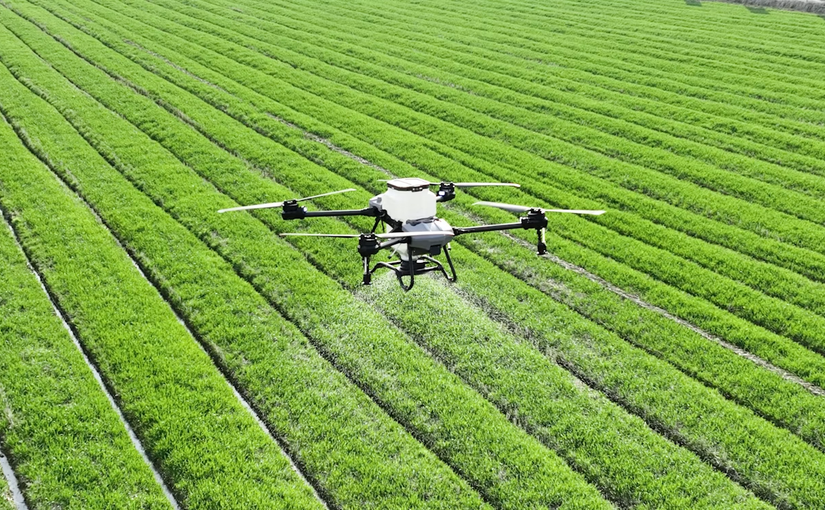
A New Kind of Farming Revolution
New Zealand has always had a strong connection with agriculture. From sheep stations across the South Island to dairy farms in Waikato and orchards in the Bay of Plenty, farming is deeply connected to the country’s economy, landscape and identity. But the image of a farmer standing in a field and making every decision by looking at the sky, soil and plants is increasingly becoming outdated.
A new agricultural revolution is taking place above those fields.
Drones, artificial intelligence, satellite imagery, connected sensors and automated machinery are changing how New Zealand farmers understand their land. Instead of waiting for a problem to become visible, farmers can increasingly identify crop stress, pests, moisture problems and nutrient deficiencies through digital tools.
The change is particularly interesting because it is not simply about replacing people with machines. In many cases, technology is giving farmers better information so they can make faster and more precise decisions.
And drones are becoming one of the most visible parts of that transformation.
Recent developments have made agricultural drones an especially interesting topic in New Zealand. In August 2026, the government announced proposed reforms intended to make routine, lower-risk agricultural drone operations easier for farmers, growers and foresters. The proposed approach would simplify the process for activities such as spraying and distributing fertiliser, lime, seeds and manure.
That could help accelerate the next stage of New Zealand’s agritech story.
Why New Zealand Is Well Suited to Smart Farming
New Zealand has a unique agricultural environment.
The country has large rural areas, varied terrain and a farming sector that serves both domestic and international markets. Some farms are enormous, while others involve specialised horticulture where precision can make a significant difference.
This creates an obvious opportunity for technology.
A farmer cannot physically inspect every plant, every paddock and every corner of an orchard every day. Even experienced farmers have limited time and resources. Weather can change quickly, terrain can be difficult and labour availability can be challenging.
Digital agriculture offers another way to see the farm.
A drone can fly over a paddock and collect high-resolution images within a relatively short period. Sensors can collect information about environmental conditions. AI systems can then analyse the resulting data and highlight areas that deserve attention.
Instead of asking, “What is happening across the whole farm?”, a farmer can ask a much more useful question:
“Where exactly is the problem?”
That shift from general observation to targeted action is at the heart of precision agriculture.
Drones Are Becoming More Than Flying Cameras
When many people hear the word “drone”, they still imagine a small aircraft carrying a camera.
Agricultural drones are much more interesting.
Modern systems can be designed for mapping, crop monitoring, spraying and other agricultural applications. High-resolution cameras can provide detailed images of fields and orchards, while specialised sensors can reveal information that may not be obvious to the human eye.
For example, a farmer might discover that one section of an orchard is developing differently from the rest. Instead of treating the entire orchard in exactly the same way, the farmer could investigate that particular area.
This approach can potentially reduce unnecessary inputs while improving the efficiency of farm operations.
New Zealand already has experience with agricultural drone applications ranging from crop monitoring to precision spraying. Industry sources describe applications across vineyards, orchards, sheep farms and other agricultural environments.
The technology is also becoming increasingly connected to software.
A drone flight can generate a large amount of information. That information can then be transferred to a computer or mobile device, where software turns aerial images into maps, measurements and alerts.
The real value is therefore not simply the aircraft.
It is the combination of the aircraft, sensors, software and human decision-making.
AI Gives the Drone a Brain
The biggest change may come when drones are combined with artificial intelligence.
A drone can collect images, but a person still needs to interpret those images. That becomes difficult when a farm produces thousands of photographs.
AI can help process this information much faster.
Imagine a drone flying across a large orchard. It captures images of thousands of trees. An AI system analyses those images and identifies unusual patterns. Some trees may show signs of stress, while others may appear healthy.
The farmer does not necessarily need to examine every image manually.
Instead, the system can highlight areas that require attention.
This is where agritech begins to look less like traditional farming equipment and more like an advanced information system.
AI can potentially assist with identifying weeds, monitoring crop health, estimating yields and detecting changes over time. Research published in 2026 is also exploring connected precision-agriculture systems that combine AI, UAVs, IoT sensors and cloud or edge computing for real-time crop monitoring.
The result could be a farm that is constantly generating useful information.
And that information can become more valuable as historical data accumulates.
The Battery Problem Behind the Drone Revolution
There is, however, a less glamorous part of agricultural drone technology that is absolutely critical: energy.
A sophisticated agricultural drone may carry cameras, sensors, communication equipment and, in some cases, a significant payload. All of these components consume power.
That means battery performance can directly affect agricultural productivity.
A drone that can remain airborne longer can potentially cover more ground during a single operation. A system that can be recharged quickly may reduce downtime between flights. Reliable power management can also become important when farmers are working around changing weather conditions and demanding schedules.
This is why the drone battery is not simply an accessory. It is a core part of the agricultural technology system.
For professional users, battery management can become almost as important as flight planning. Farmers and drone operators may need to monitor charging cycles, battery condition, operating temperatures and remaining capacity.
In large-scale agricultural operations, multiple batteries may be required to keep equipment working throughout the day.
That creates another opportunity for smarter technology.
Future agricultural drone systems could use software to estimate battery health, predict remaining flight time and recommend when a battery should be replaced. Instead of discovering a power problem in the middle of a field, operators could receive a warning before the drone takes off.
A More Precise Approach to Spraying
One of the most important agricultural applications for drones is precision spraying.
Traditional spraying methods can cover large areas quickly, but applying the same amount of material everywhere may not always be necessary.
Agricultural drones can potentially approach the problem differently.
By combining mapping, sensors and software, operators can identify areas requiring treatment and apply products more precisely. This can be particularly relevant in horticulture, where crops may be arranged in rows and conditions can vary considerably from one section to another.
New Zealand’s proposed regulatory reforms are especially relevant here. The government says lower-risk routine agricultural drone activities could move toward a simpler notification process rather than the previous certification-based approach, reducing administrative costs while maintaining safety and environmental protections.
The change matters because regulation can influence how quickly useful technology reaches ordinary farms.
If farmers can adopt practical drone solutions without excessive administrative barriers, the technology could become more accessible.
But easier access does not mean that every farm suddenly needs a fleet of drones.
The most successful applications will probably be those that solve specific problems.
From Drones to Entire Digital Farms
The future of New Zealand agritech is unlikely to be about one spectacular machine.
Instead, different technologies will increasingly communicate with one another.
A drone could collect aerial imagery.
Soil sensors could measure moisture.
Weather stations could provide local environmental information.
Satellite systems could provide broader geographic data.
A farm management platform could combine all of these sources.
AI could then analyse the information and identify patterns.
This creates a digital version of the farm.
A farmer might look at a dashboard and see which paddocks need attention, which areas are experiencing unusual conditions and which parts of an orchard are developing differently.
The farmer remains responsible for the final decisions, but the technology provides a much more detailed picture.
This is an important distinction.
Smart farming is not necessarily about removing farmers from agriculture. It is about giving them more information with which to work.
Livestock Farming Is Joining the AI Race
Agritech in New Zealand is also moving beyond crops.
Livestock management is another area where digital technology is becoming increasingly important.
AI-enabled systems can help farmers monitor animals, manage virtual fencing and understand livestock behaviour. New Zealand agritech company Halter, for example, has attracted major international attention for its AI-enabled livestock technology and virtual fencing system, with a major funding round announced in 2026 as the company prepared for further international expansion.
This demonstrates something important about New Zealand’s technology ecosystem.
The country does not need to build the world’s biggest technology industry to become influential in agritech.
It can focus on solving difficult problems that are especially relevant to agriculture.
Virtual fencing, remote monitoring, aerial surveying and precision application all address practical challenges faced by farmers.
Those solutions can then potentially be exported to other agricultural markets.
The Human Side of Agricultural AI
Despite all the excitement surrounding AI, technology alone cannot solve every agricultural problem.
Farmers still need experience.
A computer can identify a pattern, but a farmer may understand why that pattern exists. Local knowledge can be difficult to replicate with software.
For example, a farmer may know that a particular area of land behaves differently after heavy rain. An AI system may detect the change, but human experience can provide the context.
This suggests that the future of farming may involve a partnership between people and machines.
AI handles enormous amounts of data.
Farmers provide experience, judgement and practical knowledge.
Drones collect information from above.
Sensors collect information from the ground.
Together, these technologies can create a much more complete picture of agricultural conditions.
That combination could become one of New Zealand’s biggest competitive advantages.
What Happens Next?
The next few years could be particularly important for New Zealand agritech.
Agricultural drones are becoming more capable. AI systems are becoming easier to use. Sensors are becoming smaller and more affordable. Regulations are beginning to adapt to new agricultural applications.
At the same time, farmers are under pressure to improve productivity while managing costs and environmental expectations.
That creates a strong reason to experiment with precision technology.
The global agricultural drone market is also expanding rapidly. One 2026 market estimate puts the global agriculture-drone market at about US$3.45 billion in 2026, with strong growth projected through 2031.
New Zealand does not have to follow every global technology trend.
Instead, it can focus on technologies that make sense for its own geography and agricultural strengths.
That could mean drones flying over vineyards in Marlborough, monitoring orchards in Hawke’s Bay, surveying farms in Canterbury or supporting livestock operations across the South Island.
The applications may look different, but the underlying idea is the same.
Use better information to make better decisions.
The Next Farm May Look Surprisingly Different
Walk onto a New Zealand farm in the future and the landscape may still look familiar.
There may still be sheep on green hills.
There may still be tractors moving across fields.
There may still be farmers checking crops and animals in person.
But above them, something else may be happening.
Drones could be scanning fields.
AI could be analysing plant health.
Sensors could be measuring soil conditions.
Satellites could be tracking weather and vegetation.
Software could be predicting where attention is needed next.
Even the humble drone battery could become part of a sophisticated digital management system, with software monitoring its condition and predicting the best time for charging or replacement.
And as drone operations become more practical, another drone battery might power the next flight over an orchard, vineyard or pasture, turning hours of manual inspection into minutes of aerial data collection.
The real revolution, however, will not happen because farmers suddenly stop using traditional methods.
It will happen when technology becomes so useful that it naturally becomes part of everyday farming.
New Zealand has a long history of adapting agriculture to challenging conditions. The next chapter could be about adapting agriculture to an age of artificial intelligence.
The farm of tomorrow may not look like a science-fiction laboratory.
It may simply look like a normal New Zealand farm — with a drone quietly taking off in the background.
And inside that machine, another drone battery may be powering a small but important part of a much bigger transformation.